
The Alternative Commission for Social Investment – learning for Australia

alt commAustralia has a real opportunity to learn from the UK social investment market. We have an opportunity to learn from and replicate things that went well. We also have a precious opportunity to correct some of the things that didn’t go so well, rather than repeat the mistakes.

The Alternative Commission on Social Investment was established to take stock, investigate what’s wrong with the UK social investment market and to make some practical suggestions for how the market can be made relevant and useful to a wider range of charities, social enterprises and citizens working to bring about positive social change. It released its report on March 27 2015. Download the report and its summary of recommendations at the bottom of this webpage http://socinvalternativecommission.org.uk/home/.

This is an important report because it is a reflection on the UK Social Investment market by social enterprises, using information gathered from social enterprises, investors and research. It was funded by a grant from the Esmee Fairbairn Foundation, the CEO of which is Caroline Mason CBE, former Chief Operating Officer of Big Society Capital (she remains on their advisory board).

The Commission is a response to growing recognition in the UK that the social investment market is not meeting the needs of the organisations and individuals it seeks to serve. “There is a real feeling that the social investment community isn’t listening to the people on the front line” – Jonathan Jenkins, Chief Executive, Social Investment Business.

The five key underlying questions the Commission addressed are:

  1. What do social sector organisations want?
  2. Can social investment, as currently conceived, meet that need?
  3. What’s social about social investment?
  4. Who are social investors and what do they want?
  5. What can we do to make social investment better?

Particularly relevant lessons for Australia from the Alternative Social Investment Commission’s report are:

1. Minimise the hype: e.g. “Best available estimates are that the domestic market could reach A$32 billion in a decade (IMPACT-Australia 2013)”. This is not a forecast, but the most optimistic of goals. We can track the progress we do make, rather than set ourselves up for failure and disappointment. We can likewise cease talk of social investment filling the gap left by funding cuts unless there is any evidence that this has occurred.

2. Increase investor transparency: information on investments made will help organisations seeking finance navigate investors more efficiently. It will also help coordinate efforts and highlight gaps between investors.

3. Don’t just replicate the mainstream finance market for social investment: some mainstream finance models don’t transpose well to social investment – we can develop a social finance market that is fit-for-purpose and takes advantage of modern technology. There are lots of left-field suggestions in the report.

4. Understand the market we seek to serve: we can avoid some of the ‘us and them’ mentality that has arisen in the UK by seeking and listening to the voice of the investee in order to develop social investment that is useful to them.

5. Fill the gaps: similar to the UK, there is a funding gap for small, high-risk, unsecured investments. If this is the type of investment we are going to talk about all the time, let’s provide it.

6. Redefine social investors: social investors don’t have to be just rich people and financial institutions. In order to achieve the three points above, we should encourage and highlight social investments by social purpose organisations, individuals who are not ‘wholesale’ or ‘sophisticated’ investors and superannuation funds. Individual investment currently occurs in Australia through cooperatives, mutuals and small private investment. Crowd-sourced equity funding reform is being considered by the Australian Treasury and may reduce the regulatory burden and cost associated with making investments available to individuals who aren’t already rich.

This paper enables us to learn from the mistakes of the UK market. It should also encourage us to embrace our own failures and learn as we go. We can build an Australian social investment market that better meets the needs of social purpose organisations and the communities they serve.

There are actually lots of great ideas in the paper not elaborated on here – heaps of ideas for organisations and initiatives that could translate well to Australia.

If you would like to read my analysis of how each of the 50 recommendations applies to the Australian context, please download this PDF table of recommendations. Or see each numbered recommendation below with my comments in colour.


Priority recommendations for Australia

2.       Explain if and how social value is accounted for within your investments – do you expect investees to demonstrate their impact as a condition of investment? Do you offer lower interest rates based on expected impact? Are you prepared to take bigger risks based on expected impact? (Big Society Capital, SIFIs)

  • For organisations specialising in social investment this should be doable and helpful for their potential investees. A range of interest rates across investments and information about why some are higher than others could also be very helpful.

23.    Minimise all forms of social investment hype that might inflate expectations and under no circumstances imply that social investment can fill gaps left by cuts in public spending (Cabinet Office, DWP, MoJ, HMT ministers and officials, Big Society Capital, Big Lottery Fund, NCVO, ACEVO, Social Enterprise UK)

  • The repetition of statements like “Best available estimates are that the domestic market could reach A$32 billion in a decade (IMPACT-Australia 2013)” should be discouraged. Cuts in public spending may be a driver for social investment, but there is no basis for the promise that their effects will be mitigated by social investment.

24.    Avoid treating the development of the social investment market as an end itself – social investment is a relatively small phenomenon overlapping with but not the same as ‘access to finance for social sector organisations’ and ‘increasing flows of capital to socially useful investment’. These wider goals should be prioritised over a drive to grow the social investment market for its own sake– (Cabinet Office, Big Society Capital)

  • All those who are involved in ‘building the market’ should clarity their efforts in terms of their contribution to these wider goals. Many already do. The second goal may need some rewording.

30.    Provide opportunities and support for citizens to invest in socially motivated pensions (HM Treasury)

  • There exists some opportunity for citizens to invest in socially motivated superannuation, but this could be broadened across more superannuation funds.

32.    Social investors should better reflect and understand the market they are seeking to serve by getting out and about, meeting a broader range of organisations – particularly organisations based outside London – recruiting from the sector and cutting costs that deliver no social value – (SIFIs)

  • Social investment organisations in Australia may have less of a problem with this than in the UK, but certainly there is little evidence of the financing needs of potential investees in social investment policies and strategies so far

36.    Don’t replicate expensive models from mainstream finance, do explore how to use social models and technology to keep costs down (Big Society Capital, SIFIs)

  • There is opportunity to develop a social finance market that is fit-for-purpose, rather than simply transposed from conventional finance

46.    Ignore hype about the social investment market – (Umbrella bodies, SSOs)

  • The hype is still so pure in Australia that many social sector organisations are repeating it, with very few doubting its validity yet

50.    Understand that just being socially owned may not be enough – you don’t have to care about impact frameworks but need to recognise that an investor will want to know how you are managing your success at what you claim to do (SSOs)

  • Some definition of success and measure of progress may be required- it’s worth being aware of this and preparing when approaching investors

34.    Focus on additionality and filling the gaps esp small, patient risky, equity-like – (Big Society Capital, Key Stakeholders, SIFIs)

  • Even in our nascent market, these gaps are emerging.

42.    ‘Crowd in’ people who aren’t rich – support models of social investment that enable investments from people with moderate incomes and assets, and remove barriers that prevent smaller investors from accessing tax breaks such as SITR (HMT, Cabinet Office, Big Society Capital, SIFIs)

  • Currently occurring largely via cooperative models. For other models, reliant on private investment, regulatory change (currently being considered) or full prospectus issuing. Tax breaks are not currently available but may become so.

44.    Back yourselves and invest in each other – Social sector organisations should consider cutting out the middleman and developing models where they can invest in each other, where legal and appropriate – (SSOs)

  • There are examples of this occurring, but potential for more. Australian social purpose organisations are wealthy by UK standards and there is greater potential for this here.

Directly applicable to Australia

1.        Publish information on all social investments across all investors – with investees anonymised if required (Big Society Capital, SIFIs, the Social Investment Forum)

  • All self-identifying social investors (institutions, foundations and individuals) could be encouraged to do this. Could also be useful for it to be collated somewhere as a database. Consideration would need to be given for negative consequences. Has begun to a certain degree e.g. SEDIF progress report 2013 http://docs.employment.gov.au/node/32639 and WA Social Enterprise Fund Grants Program http://www.communities.wa.gov.au/grants/grants/social-enterprise-fund-grants-program/Pages/default.aspx  The suggestions from delegates at roundtables are useful. They called for upfront transparency from social investors on:
    • what they will and won’t fund
    • where the money goes
    • the terms of investment
    • how to present a case for investment
    • what the application process will involve.

6.       Be clear about terminology – what specifically do you mean by, for examples, ‘social investment’, ‘impact investment’, ‘finance for charities and social enterprise’ – and consistent across government departments (Cabinet Office, Big Society Capital, SIFIs, Big Lottery Fund, Umbrella Bodies)

  • Many people who use these terms currently define them, but it may still be useful to encourage this practice as the Australian market develops

7.        Clarify how much is in dormant bank accounts – look at other unclaimed assets, insurance, Oyster cards, Premium Bonds, and other products. (Cabinet Office, Big Society Capital)

  • Australian governments could research unclaimed public funds that could be put to good use

9.       Publish details of investments made on your website – to enable Social Sector Organisations to understand the size and type of investments you make (SIFIs)

  • Organisations, families and individuals that make social investments could be encouraged to do this

10.    Be transparent about costs – be clear about what fees you charge and why (Big Society Capital, SIFIs)

  • Some social investors do this already but it could be encouraged generally as good practice

25.    Consider the ‘wider universe’ of socially impactful investment including additional research on the £3.7 billion investment in SSOs primarily from mainstream banks (Umbrella bodies, Researchers, Big Society Capital, Mainstream Banks)

  • Australia has very little research on socially impactful investment at all, so this is a good consideration as we develop new research projects.

26.    Consider how SSOs can be better supported to access mainstream finance through guarantees and other subsidies, and through information and awareness-raising (HMTreasury, Cabinet Office, Big Lottery Fund)

  • Unsure who might take this on, but good to consider for organisations that want to support social sector organisations.

28.    Promote greater focus on socially motivated investment in HMT, BoE, and FCA and BIS – (Politicians, Cabinet Office)

  • Key institutions for mainstream investment market should be involved in or at least invited to social investment initiatives.

31.     Work together in equal partnership with the social sector to develop a set of principles for what makes an investment ‘social’ – (Cabinet Office, Big Society Capital, Big Lottery Fund, SIFIs, Umbrella bodies, the Social Investment Forum, SSOs)

  • This could be one that Impact Investing Australia could lead.

37.     Explore alternative due diligence models including developing common approaches to due diligence for different types of social investment – (Social Investment Forum, SIFIs, Big Society Capital)

  • Social investment organisations may have some learning to share – unsure.

39.    Support the development of a distinctively social secondary market for social investments where early stage investors will be able to sell on investments to investors with similar social commitment but less appetite for risk (Cabinet Office, Big Society Capital, Access)

  • This does not exist in Australia (although there are instances where it has occurred) – could be a good idea to build/test with our tiny market in anticipation of growth. Not obvious who would take this forward.

45.    Large asset-rich social sector organisations should consider supporting smaller organisations to take on property either by buying it for them or helping them to secure it by providing a guarantee facility where legal and appropriate (SSOs)

  • This may already occur – seems logical

49.    Identify what is ‘social’ about the investment approach that you are hoping for from investors: are you expecting cheaper money, higher risk appetite, more flexibility, more ‘patient’ capital, wrap around business support? (SSOs)

  • This should help both investees and investors define each deal and subsequently, the market

Possibly applicable to Australia

11.     Be clear about what is ‘social’ about you approach to investment – what is it that you are doing that a mainstream finance provider would not do – and why is it useful? Mandatory statement of fact sheet. Report on overheads. (Big Society Capital, SIFIs)

  • It is not obvious who would make this mandatory or why. But the question is interesting and a standardised ‘fact sheet’ could help potential investees navigate the investor market.

22.    More funders should consider their possible role in social investment wholesaling including British Business Bank, Esmee Fairbairn, Unltd, Nesta, Wellcome Trust (Funders)

  • There may be potential for some wholesaling, perhaps by superannuation funds or other large funds with a social investment remit

33.     Employ more social entrepreneurs and others with social sector experience – take on more staff with direct, practical experience of using repayable finance to do social good and enable them to use that experience to inform investment decisions (Big Society Capital, SIFIs)

  • This may be something to keep in mind as employment by social investment organisations increases, as does number of people with repayable finance experience, but might be a bit early and this may not be a problem here

38.    Support the development of Alternative Social Impact Bonds options include: (a) models which enable investors from the local community to invest relatively small amounts of money with lower expected returns making them less expensive in the long-term to the public purse, more attractive and replicable; (b) a waterfall approach that sees X% of performance above a certain level reinvested in the enterprise the community (Cabinet Office, Big Society Capital, SIFIs, SSOs)

  • The paper doesn’t expand on these suggestions. (a) is relatively clear and in Australia relies on either regulatory change or small private investments (b) is not expanded on in the report and is thus unclear –  may already be happening under a couple of different guises

43.    Create a ‘Compare the market’/’trip advisor’ tool for social investment – enabling organisations to rate their experiences and comment – (Umbrella bodies and SSOs)

  • While nice in theory, there may not be enough social investors and deals made for this to be meaningful. Could be a good thing to start and build over time

47.    Go mainstream – if looking for investment, consider banks and other investors and not just specifically social investment (SSOs)

  • The bulk of financing for social purpose organisations in Australia is mainstream banks and investors

48.    Before seeking investment, work out whether you are looking for repayable investment or whether you are looking for a grant – (SSOs)

  • There is no clear evidence that this solves a problem we have in Australia

Unsure of applicability

8.       Publish asset management strategies – including details of how endowments are invested in a socially and environmentally responsible manner. (Big Society Capital, SIFIs)

  • Unsure what effect would be in Australia

27.    Apply an added value test before supporting funds and programmes designed to develop ‘the social investment market’, be clear about the likely social outcomes that social investment offers that could not be better delivered another way (Cabinet Office, Big Lottery Fund)

  • Very difficult to be clear that social outcomes could not be better delivered in another way and would not like to discourage simultaneous initiatives

29.    Consider providing guarantees for social investment via crowdfunding platforms based on clear position on what ‘social investment’ means in this context (Cabinet Office, Access)

  • At the moment Australians cannot invest in Australian organisations via crowdfunding platforms

35.     Consider the risk of the social investment market failing to make a significant number of demonstrably social investments at all alongside the risk of some of those investments being unsuccessful (Big Society Capital, SIFIs)

  • This is very broad and how it might be implemented is unclear

Not applicable

3.        Explain who Big Society Capital (BSC)- backed market is for – Be clear about how many social sector organisations can realistically expect to receive investment from the BSC backed market (assuming it works). If it’s 200, be honest about that (Politicians, Cabinet Office, Big Society Capital)

  • No Big Society Capital equivalent

4.       Explain what Big Society Capital (BSC)-backed market is for – Be clear on policy positions on crowding in/crowding out – is the point of BSC to bring mainstream investors in or grow the social investment market to crowd them out? (Cabinet Office, Big Society Capital)

  • No Big Society Capital equivalent

5.        Explain the relationship between Big Society Capital and the Merlin banks – What is the banks role (if any) in governance and strategy? Under what circumstances would they receive dividends? (Cabinet Office, Big Society Capital)

  • No Big Society Capital equivalent

12.    Reconsider the role of Big Society Capital – prioritise building a sustainable and distinctively social investment market over ‘crowding in’ institutional finance into a new market doing – (Big Society Capital, Cabinet Office)

  • No Big Society Capital equivalent

13.     Consider splitting the investment of Unclaimed Assets and Merlin bank funds. Unclaimed Assets, allocated by law to Social Sector Organisations, could be invested on terms that better meet demand than currently, while Merlin bank funds could be invested in a wider group of organisations, with a focus on positive social value – (Big Society Capital, Cabinet Office)

  • No Big Society Capital equivalent

14.    Consider demarcating the unclaimed assets spending as ‘social investment’ and the Merlin funds as ‘impact investment’ – (Cabinet Office, Big Society Capital)

  • No Big Society Capital equivalent

15.     Particularly consider investing some Merlin funds in CDFIs & credit unions that provide finance for individuals and mainstream businesses in response to social need (Big Society Capital)

  • No Big Society Capital equivalent

16.    Bear more transactions costs – particularly those costs which are imposed on SIFIs through demands for extensive legal processes (Big Society Capital)

  • No Big Society Capital equivalent

17.     In the event that it becomes profitable, before paying out dividends to shareholders Big Social Capital should allocate 50% of profits into a pot of funding to reduce transaction costs for SIFIs enabling them to reduce the cost of finance for SSOs (Big Society Capital)

  • No Big Society Capital equivalent

18.    Be more flexible in supporting SSOs to engage with public sector outsourcing and be supported by policymakers to do so learning lessons from the experience of the MoJ Transforming Rehabilitation fund (Big Society Capital)

  • No Big Society Capital equivalent

19.    Consider democratising Big Society Capital board – Or at least be more open and clear about who has controlling stakes and vetoes within its structure . Consider how to make both board and staff team more representative of the sectors that they serve (Big Society Capital, Cabinet Office)

  • No Big Society Capital equivalent

20.    Change the name ‘Big Society Capital’ to something less politically charged – (Big Society Capital, Policymakers)

  • No Big Society Capital equivalent

21.    Consider whether all remaining funds in dormant bank accounts need to be invested in Big Society Capital or whether remaining funds could be used in other ways – for example, creating local or regional social investment funds controlled by local people (Cabinet Office)

  • No Big Society Capital equivalent

40.    Consider the practicality of establishing a simple registration and regulation system for organisations eligible for social investment – as supported by unclaimed assets – with unambiguous criteria for registration of organisations who consider themselves to be ‘social’ but not use a recognised social corporate structure – (Cabinet Office)

  • It is not obvious what this registration would enable in Australia as our market currently exists

41.    Listen to the people – find out what (if anything) citizens in general think about social investment (Cabinet Office, Big Society Capital, SIFIs)

  • Australian citizens in general may not think about social investment, more than likely they’ve never heard of it. It is not obvious who would collect this information and what they would do with it

Response

Civil Society Finance, 27 March 2015, Social investment problems include ‘too much hype and hubris and not enough transparency’ says report
Third Sector, 27 March 2015, Growing the social investment market requires more investor transparency, report says
Social Investment Business, 27 March 2015, Jonathan Jenkins Responds to the final Report from The Alternative Commission on Social Investment
Unit costs – what do they mean?

unit costs

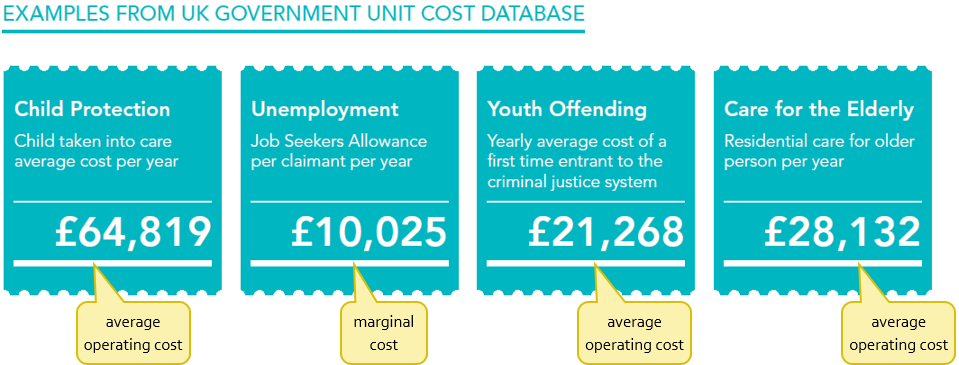
Both the G8 Social Impact Investment Taskforce report and Impact Investing Australia’s report to the G8 have called for publication of unit costs of government services, in order to encourage social innovation and social investment. The assumption behind this seems to be that:

  1. If people know the cost of delivering something, then
  2. They might develop a preventative social program that allows these costs to be avoided, which
  3. Saves the government money, and
  4. Delivers better social outcomes for the population.

Well this may be true for things like employment services, where the government saves cash by not paying unemployment benefits. But you might not get a lot of enthusiasm from some other parts of government. And that’s because a reduction in demand for government services doesn’t necessarily mean that government saves money. In order for this to happen, costs must be able to be recouped i.e. they must be marginal, reflecting the additional cost to the system of more people requiring more services. Marginal costs represent what can be saved if this government service isn’t required. So it all depends on how government spending currently occurs.

Let’s take a look at types of unit costs and how they are calculated. And then see what this means using the reoffending unit cost examples from the NSW Government’s Office of Social Impact Investment:

Unit cost How is it calculated NSW example  What does it mean? What’s it useful for?
Average operating cost Divide entire budget, (including the cost of things like the head of the department and their staff) by service units e.g. total nights spent in custody in one year It costs Corrective Services NSW $189 per day to keep an inmate in custody. Savings may result in response to reduced demand if a prison or wing of a prison closes, but only if staff are sacked and the prison is not maintained. Useful for governments to benchmark their costs against other governments or identify trends in their expenditure over time.
Cost of time and other items Work out how much time is spent on something and the salaries of the people spending that time. Add in any incidentals like photocopying, petrol, travel. It costs NSW Police $2,696 to finalise an offending event in court. This represents time that could be spent on other tasks- If the number of crimes drops, Police are more likely to reallocate their time, than be sacked. Time, rather than money, is saved. Useful for governments to analyse ways to better allocate human resources.
Capital expenditure Look at budget for new buildings in response to increasing demand. This was not a cost given by NSW Government, but new prisons can cost several hundred million. If demand can be reduced by a certain proportion and maintained for a certain period of time, a new prison may be avoided and the amount budgeted for it maybe saved. Useful for looking at long-term government budget allocations and thinking about the best ways to spend a given amount of money.
Marginal cost (sometimes referred to as cashable savings) The cost of things purchased specifically for one more unit of service  i.e. new trainers, toothbrush, appointments with psychologists, water for washing clothes, food for one more person. It costs Corrective Services NSW $19 per day for every additional inmate in custody Every time a unit of service is avoided, the government can avoid spending this much money. Useful for people outside government to understand their potential impact on government expenditure.

If we assumed that cash recovered from NSW marginal costs were used to fund preventative services, we would:

  • take the $19 per day marginal cost
  • multiply it by the 49% of unsupervised parolees that reoffend within 12 months[1]
  • multiply it by the average 1.8 proven offences they commit in within 12 months[2]
  • multiply it by the 31% of those proven offences that are sentenced to prison[3]
  • and multiply it by the 8 out of 12 months we expect these people to spend in prison from those sentencing (average sentence is 486 days[4] and average time of entry during 12 months post-release is around four months after release[5]).

Then we’d have $3.48 per person per day to spend on our services over the first 12 months. Not a lot.

This doesn’t mean that it’s not worth spending money on preventative services for people who are released from prison. It just means that we need to realise that this isn’t a ‘no brainer’ for government and that it’s a serious spending decision that has to be weighed up against other uses for the cash. It’s certainly not the hugely misleading [6] calculation put forward in the G8 Social Impact Investment Taskforce report:

“Say, for example, that a £10 million, five-year SIB for reducing recidivism delivers an 8% financial return and significant social impact by succeeding in rehabilitating 1,000 youth offenders, each of whom would have cost the UK government £21,268 a year. Using the Unit Cost Database gives a value for the social outcome in just the first year of £21 million, and an associated social return per annum of about 15% (internal rate of return) for the SIB” (p.16).

In order for unit costs to be useful, we need to be informative and realistic about what they represent. Marginal costs will reduce as demand falls. But people quoting average operating costs back to government as if they represent savings? Not so helpful.

[1] http://www.dpc.nsw.gov.au/__data/assets/pdf_file/0003/168339/Statement_of_Opportunities_2015_WEB.pdf p8

[2] http://www.dpc.nsw.gov.au/__data/assets/pdf_file/0003/168339/Statement_of_Opportunities_2015_WEB.pdf p8

[3] http://www.dpc.nsw.gov.au/__data/assets/pdf_file/0003/168339/Statement_of_Opportunities_2015_WEB.pdf p8

[4] http://www.bocsar.nsw.gov.au/agdbasev7wr/_assets/bocsar/m716854l11/nswcustodystatisticsdec2014.pdf p22

[5] http://www.dpc.nsw.gov.au/__data/assets/pdf_file/0006/168873/Market_Sounding_-_Reducing_reoffending_and_return_to_custody.pdf p12

[6] Six fallacies of this calculation can be read here http://www.themandarin.com.au/5274-will-publishing-unit-costs-lead-social-investment/

Delivering the Promise of Social Outcomes: The Role of the Performance Analyst

I’ve wanted to write about performance management systems for a long time. I knew there were people drawing insights from data to improve social programs and I wanted to know more about them. I wanted to know all about their work and highlight the importance of these quiet, back-office champions. But they weren’t easy to find, or find time with.

Dan
Dan Miodovnik, Social Finance

I worked at Social Finance in London for three months in late 2013, a fair chunk of that time spent skulking around behind Dan Miodovnik’s desk. I’d peer over his shoulders at his computer screen as he worked flat out, trying to catch a glimpse of these magic performance management ‘systems’ he’d developed. At the end of my time at Social Finance, I understood how valuable the performance management role was to their social impact bonds (SIBs), but I still had no idea of what it actually entailed.

Antonio Miguel, The Social Investment Lab


Then early 2014 Antonio Miguel and I took a 2-hour bullet train ride through Japan while on a SIB speaking tour. On this train journey I asked Antonio to open his computer and show me the performance management systems he’d worked on with Social Finance. Two hours later, I understood the essential components of a performance management system, but I didn’t fully grasp the detail of how these components worked together.

So I proposed to Dan that we join Antonio on the beaches of Cascais in Portugal in August 2014. My cunning research plan was to catch them at their most relaxed and pick their brains over beach time and beers. Around this time I saw a blog written by Jenny North, from Impetus-PEF that mentioned performance management. A call with her confirmed that they were as enthused about performance management as I was. So I drafted a clean, six-step ‘how to’ guide for constructing a performance management system. I hoped that a quick edit from Dan and Antonio, a couple of quotes and I’d be done.

Interviewing Dan and Antonio blew me away. Only when I heard them talk freely about their work did I realise the magic wasn’t in their computer systems, it was in their attitudes. It was their attitude to forming relationships with everyone who needed to use their data. It was their attitude to their role – as the couriers, rather than the policemen, of data.

They told me that there were plenty of ‘how to’ guides for setting up systems like theirs, but that the difficult thing was getting people to read and implement them.

Isaac Castillo, DC Promise Neighbourhood Initiative

They suggested I throw out my draft and interview more people. People who were delivering services and their investors. I didn’t just need to understand the system itself, I needed to understand what it meant for the people who delivered and funded services. I gathered many of these people at San Francisco’s Social Capital Markets (SOCAP) conference and several more from recommendations. One of these recommendations was Isaac Castillo, who works with the DC Promise Neighbourhood Initiative’s collective impact project. He is now managing not only his team of performance analysts, but the service delivery team too. It’s revolutionary, but it makes complete sense.

Interviewing these people has been a most humbling experience. It has revealed to me the extent of their dedication, innovation and intelligence. It has also revealed to me how little I knew, and in turn, how little we, as a sector, know about these people and their work. I am honoured to share their stories with you – please read them at deliveringthepromise.org.


This research is published by The Social Investment Lab (Portugal), Impetus-PEF (UK) and Think Impact (Australia).

logos in row

Malaysian Innovation: Building a Social Impact Bond (SIB) Pipeline

Agensi Inovasi Malaysia, part of the Malaysian Government, has embarked on a journey towards Social Impact Bonds that reflects the Malaysian social and policy context. There are three innovative features of their program, ‘Social Service Delivery’, worth highlighting:

  1. Explaining SIBs as a public-private partnership for social good
  2. Creating a market of new interventions to contract via a SIB
  3. Exploring Islamic finance as a source of SIB funding

Let’s explore each of these innovations in turn.

Explaining SIBs as a public-private partnership for social good

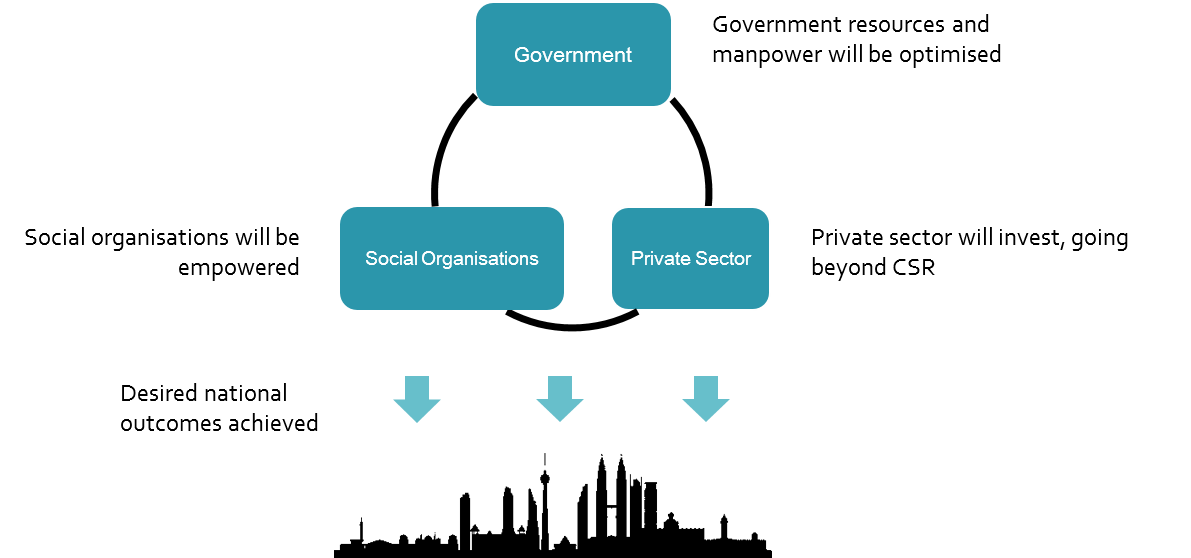
Social Impact Bonds were first implemented by an organisation called Social Finance in the UK in 2010. The idea has since generated interest all over the world. The concept can be overwhelming for stakeholders, who seek to understand how far away this model might be from their current reality. In Malaysia, Social Impact Bonds have been framed as the logical next step after the recent introduction of other long-term partnerships and privately financed initiatives (PFIs) towards new infrastructure such as buildings and roads. The 2010 New Economic Model for Malaysia from the National Economic Advisory Council called for ‘academia, business, the civil service, and civil society’ to ‘work together in partnership for the greater good of the nation as a whole’ (Part 1, p. 68). Social Impact Bonds are one vehicle by which these recommendations will be delivered. They are an arrangement where a non-government organisation delivers an intervention that is first financed by private investors who stand to be repaid with interest from government funding if a social outcome is achieved. There are incentives for each stakeholder to be involved (see the Agensi Inovasi Malaysia diagram below).

Diagram of objectives of program

(Agensi Inovasi Malaysia)

Creating a market of new interventions to contract via a SIB

Most jurisdictions that have developed a SIB have first scanned their market for investors, intermediaries and proven or promising social delivery organisations. And then they’ve thought about how to run a procurement process that brings the best of these players together, along with an intervention to achieve a priority outcome for Government. Although procurement approaches have varied, all have rested on the ability of the market to delivery suitable interventions that can be managed by organisations with sufficient capabilities to produce the desired social outcomes. Agensi Inovasi Malaysia has enhanced their opportunity to engage with capable service providers by holding a competition for new ideas in priority areas, and then incubating and collecting evidence on these new initiatives, with the end goal of a Social Service Delivery contract. This is not only a way to provide services that are suitable for the first Social Impact Bonds in Malaysia, but creates a pipeline of evidenced programs for the future.

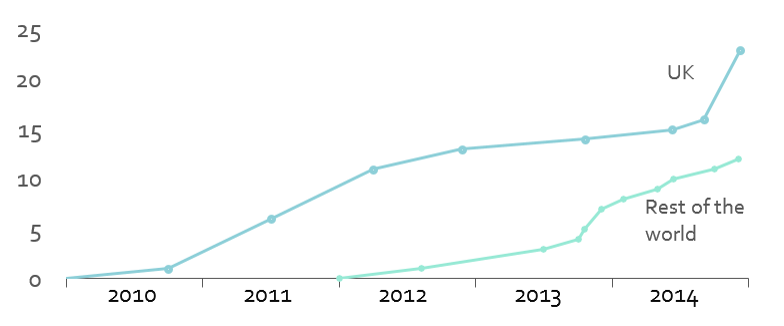
Social impact bonds emerged in the UK in 2010, with 23 currently in operation. Development plateaued, however, during 2013 and 2014 (see chart below).

SIBs launched white background

In the latter half of 2013, attention turned to the development of a pipeline of SIBs to bring to market. Big Lottery Fund and the UK Cabinet Office are working together on “a joint mission to support the development of more SIBs” through their social outcomes funds totalling £60 million. Social Finance, in partnership with the Local Government Association, has been commissioned to support applicants to their funds and there is also a program of grants for organisations requiring specialist technical support to apply (Big Lottery Fund).

Agensi Inovasi Malaysia will potentially avoid the problems of the UK, by seeding and supporting a pipeline of interventions up front. This pipeline has been created through the ‘Berbudi Berganda: Social Impact Innovation Challenge’ which called for social organisations to submit their ideas for interventions to tackle the priority issues of:

  • youth unemployment
  • homelessness
  • elderly care.

The top 12 organisations won funds and support to implement their ideas, the impact of which will be the subject of action research over their first four months. This research will form the basis of a framework and delivery model addressing the priority issues. The pilot program timeline is below.

Apr 2014 Feasibility study
Sep 2014 Focus group discussion
Oct – Nov 2014 Social Innovation Challenge
Jan – Apr 2015 Incubation
Jan – Apr 2015 Intervention
Jan – Apr 2015 Action research and impact study
2015 Social Finance Policy Framework
2015-16 Model for ‘Social Service Delivery’

The benefits of the competition and incubation approach include:

  • focusing NGO innovation in government priority issue areas
  • government being able to work with NGOs over a longer period of time, thus gaining a better understanding of the ability of the organisation to deliver effective programs and outcomes
  • creating an evidence base that will inform the design of ‘Social Service Delivery’
  • supporting organisations to build and test interventions suitable for a Social Impact Bond.

The Agensi Inovasi Malaysia approach might require more up-front government funding than other jurisdictions have been or will be able to provide. But for a government that has limited experience outsourcing social services, it is a collaborative and supportive way to create a market of interventions that might otherwise not exist.

Exploring Islamic Finance as a source of SIB funding

The potential for Islamic finance to become a source of funding for Social Impact Bonds is significant and has not yet been explored. The Islamic religion obliges its followers to give the zakat, a portion of their wealth to ease inequality and suffering. The total given each year is estimated at 15 times that of global humanitarian aid contributions, and in Malaysia the zakat collected by Government is over US $400 million (Irin News).

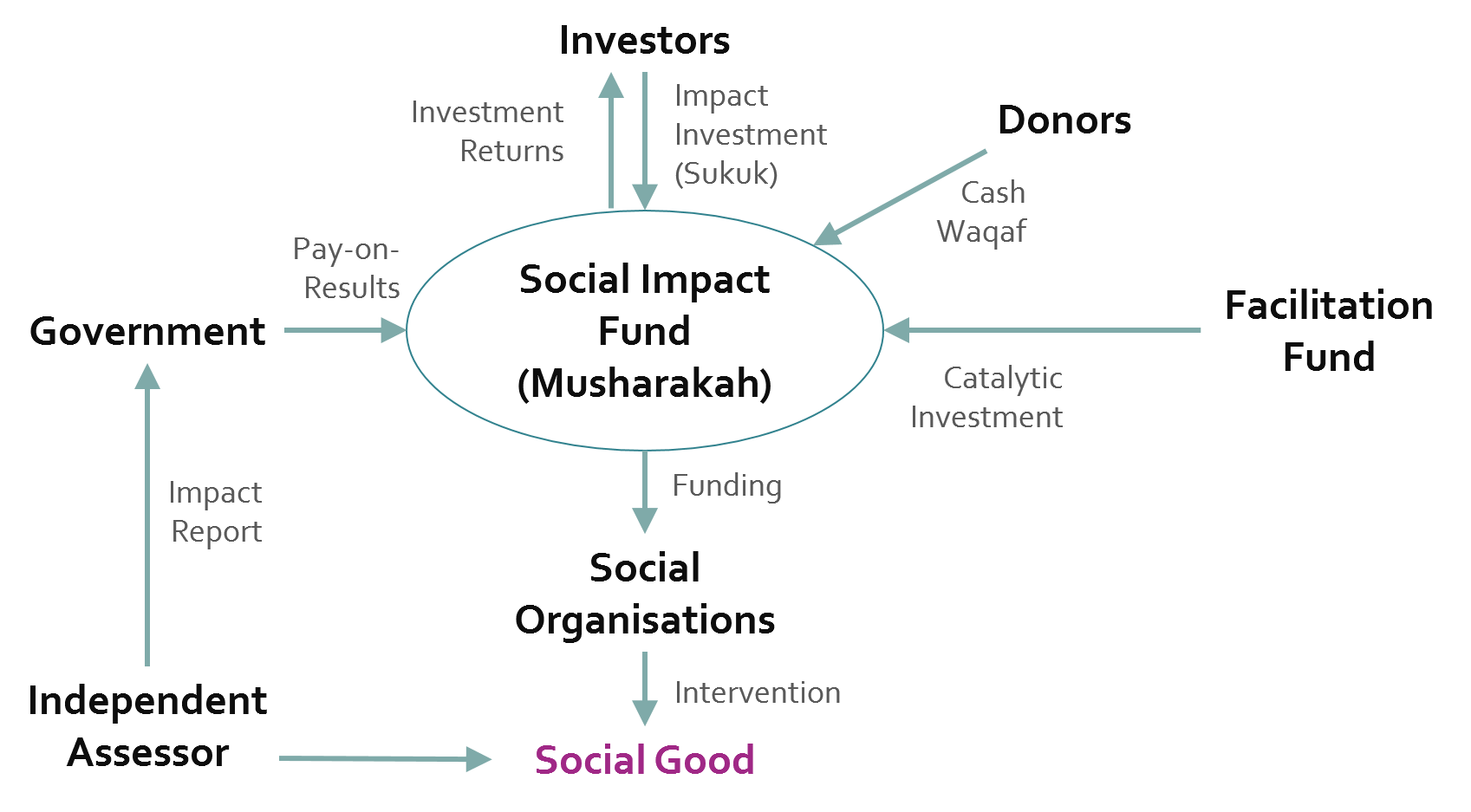
Islamic finance includes Musharakah (Joint Venture Partnership), Waqaf (charitable donations), Debt Structure, and Sukuk (Islamic Bonds). A Musharakah could be used as the structure that holds the contracts with other parties. Sukuk could be used for investment, although their flexibility in terms of repayments that are dependent on outcomes will need to be determined. Waqaf could be used to fund a specific fixed cost such as legal fees, extra staff for development of a SIB, software, premises, audit, insurance, performance management or evaluation. The way this could fit into a Social Impact Bond structure is shown below.

Malaysia 2

Conclusion

Agensi Inovasi Malaysia has created a unique pathway towards Social Impact Bonds. Their approach mitigates the risks of implementing the model in a country without a history of outsourcing social services. They have framed this new contracting model in the broader policy context of public-private partnerships, which aids wider understanding of both the model and the objectives of government. By seeding and supporting new programs that address priority issues, the Government will be able to understand and evidence the impact of these new programs, before contracting them for ‘Social Service Delivery’. Finally, the exploration of the role Islamic finance can play in a Social Impact Bond has the potential to be applied in other jurisdictions and extends the ability of Islamic finance to achieve social outcomes.

This blog was written as a result of a project Emma is working on with Agensi Inovasi Malaysia. It describes aspects of their programs that she found interesting and relevant. These are Emma’s personal views and should not be taken as representative of Agensi Inovasi Malaysia or any other organisation. 

Procurement precedents for social impact bonds (SIBs)

There are many ways to procure for a SIB. The following examples of procurement processes have been chosen to demonstrate variation. The advantages and disadvantages of each are context specific – if you are developing a new procurement process you might want to think about whether each variation promotes or hinders your objectives.

I the word ‘procurement’ to refer to any of the means by which governments might ask external organisations to deliver a service under contract.

Please refer to the source information if you are producing further publications – I have tried to faithfully summarise each procurement process, but my interpretations have not been checked with the parties involved. Happy to accept corrections or suggestions.

Ontario, Canada

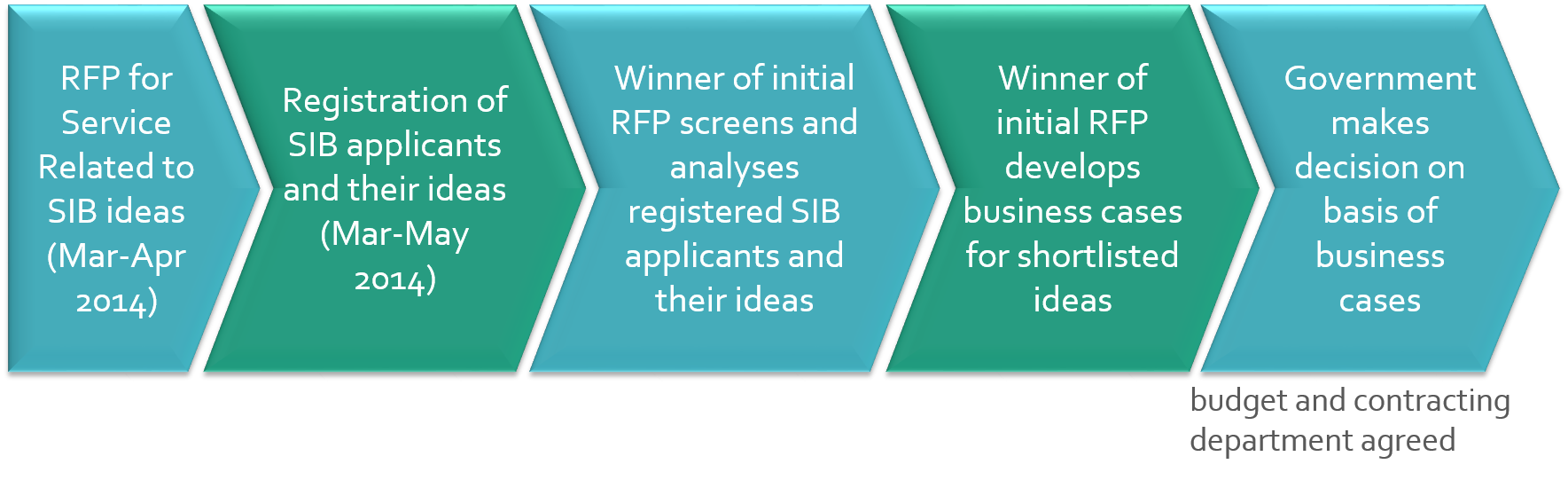
Deloitte won the initial RFP is currently in the final stages of that contract, with an Ontario Government decision expected in the next few months. An interesting feature of this process is the parallel ‘internal’ and ‘external’ streams, where public servants are proposing their outcome ideas at the same time as people in the market are also proposing. External ‘registrations’ of interest were called for in the following priority areas:

  • Housing – Improving access to affordable, suitable and adequate housing for individuals and families in need.
  • Youth at Risk – Supporting children and youth with one or more of the following: overcoming mental health challenges, escaping poverty, avoiding conflict with the law, youth leaving care, Aboriginal, racialized youth, and other specific challenges facing children and youth at risk, for example employment.
  • Employment – Improving opportunities for persons facing barriers to employment, including persons with disabilities.

procurement Ontario

New South Wales, Australia

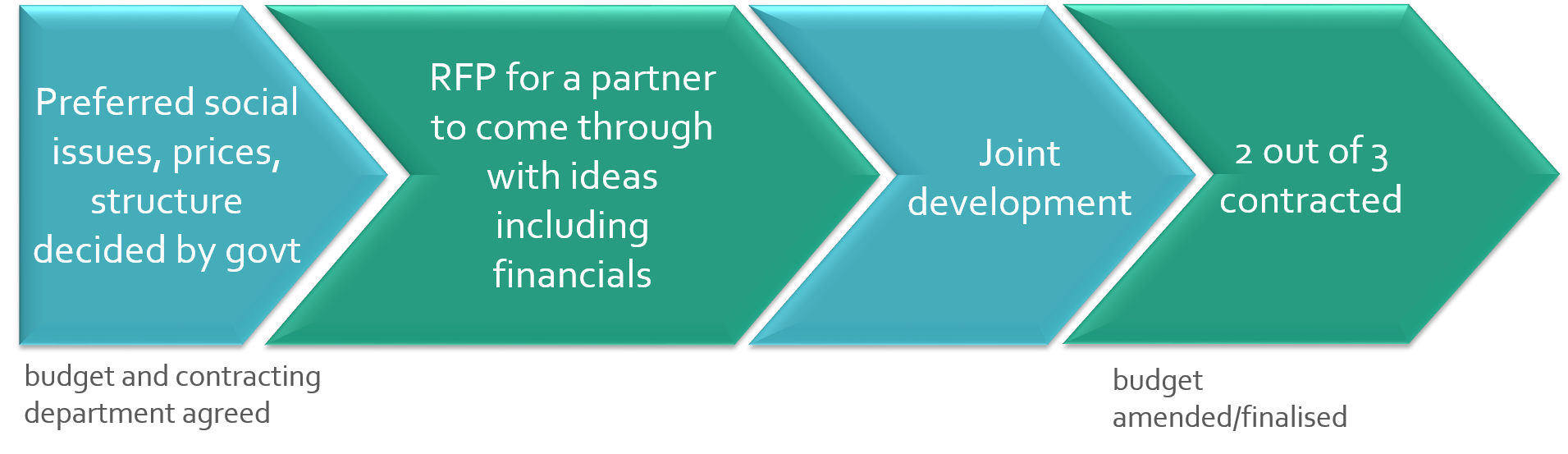
In New South Wales we suffered from locking ourselves out of developing the idea with organisations over the 6 months it took to run RFP and negotiate the contracts for the next stage. We did not agree a maximum budget or referral mechanism until the joint development stage – we asked for organisations to come up with these as well as a full economic and financial model in their RFP. None of us who were involved in designing the procurement process feel we got it quite right, yet given the opportunity, we would all redesign it in different ways! (See NSW Treasury page on ‘Social Benefit Bonds’)

procurement NSW

Procurement timeline:

November 2010 NSW Government commissions a feasibility study from Centre for Social Impact
February 2011 SIB Feasibility Study report submitted  and published
March 2011 State government elections and change of government (left to right)
September 2011 (due Nov) SBB Trial Request for Proposal released
March 2012 3 consortia announced joint development phase begins
March 2013 Newpin Social Benefit Bond contracts agreed
June 2013 Benevolent Society + 2 banks Social Benefit Bond contracts agreed

New York City, USA

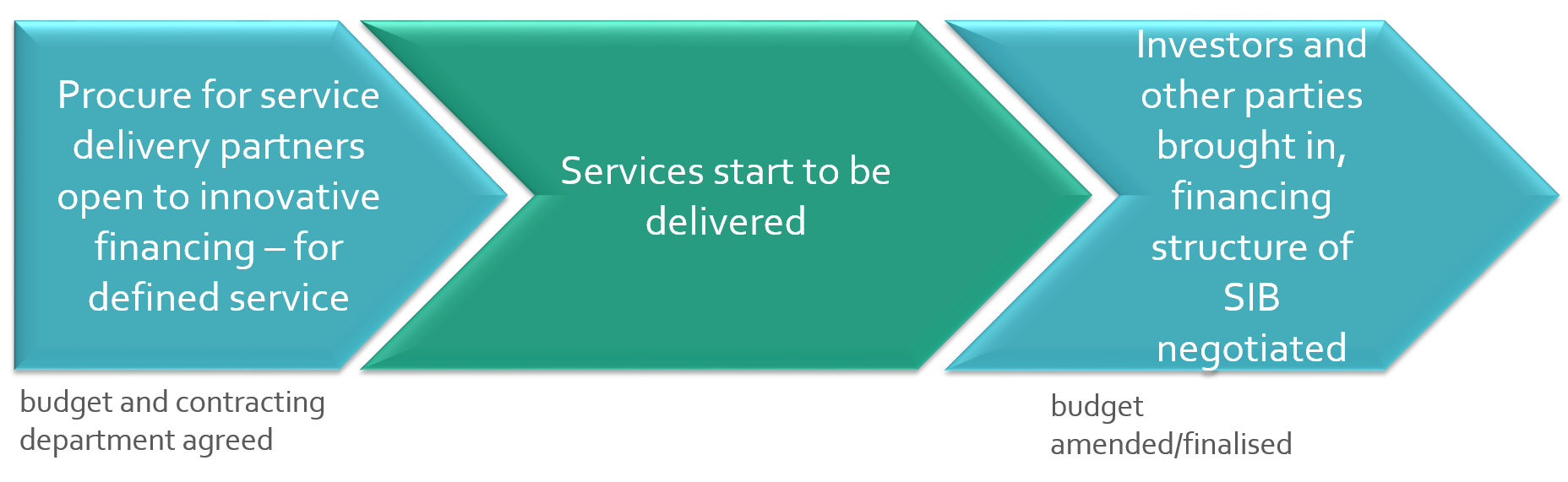
An interesting feature of the New York City SIB development process was that service delivery partners were procured for first, and started delivering services while being involved in developing a SIB for future financing of the service.

procurement New York City

New Zealand

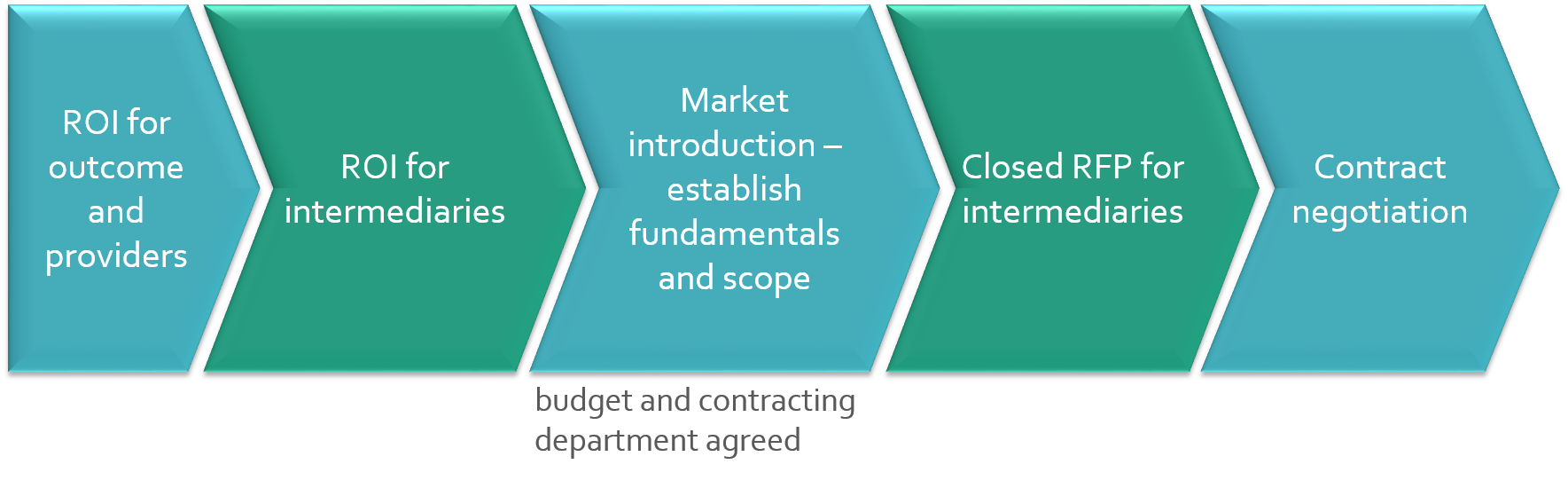
The New Zealand process appears to be the only one where the government procured for the intermediaries and service providers separately. It is not yet clear what the benefits of this might have been or how they will be matched up.

procurement New Zealand

Massachusetts

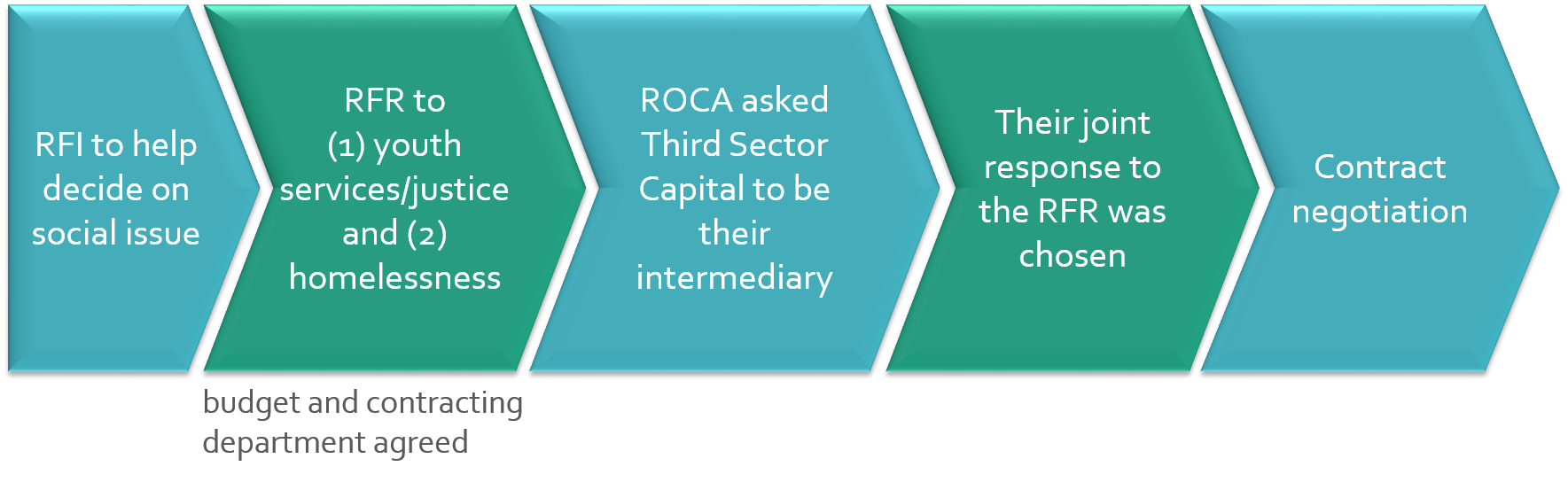
Several US states have followed a similar procurement process to Massachusetts, which first involved a Request for Information from organisations external to government. This approach allows the market to shape government thinking and recognises that there may be social issues and intervention types that government hasn’t previously considered. Some jurisdictions have accomplished this with less formal consultations e.g. Queensland Government’s cross-sector payment-by-outcomes design forum and Nova Scotia Government’s cross-sector SIB Working Group.

procurement Massachusetts

Massachusetts Selection Criteria:

  1. Government leadership to address and spearhead a public/private innovation.
  2. Social needs that are unmet, high-priority and large-scale.
  3. Target populations that are well-defined and can be measured with scientific rigor.
  4. Proven outcomes from administrative data that is credible and readily available in a cost effective means.
  5. Interventions that are highly likely to achieve targeted impact goals.
  6. Proven service providers that are prepared to scale with quality.
  7. Safeguards to protect the well-being of populations served.
  8. Cost effective programs that can demonstrate fiscal savings for Government.

Department of WOrk and Pensions UK

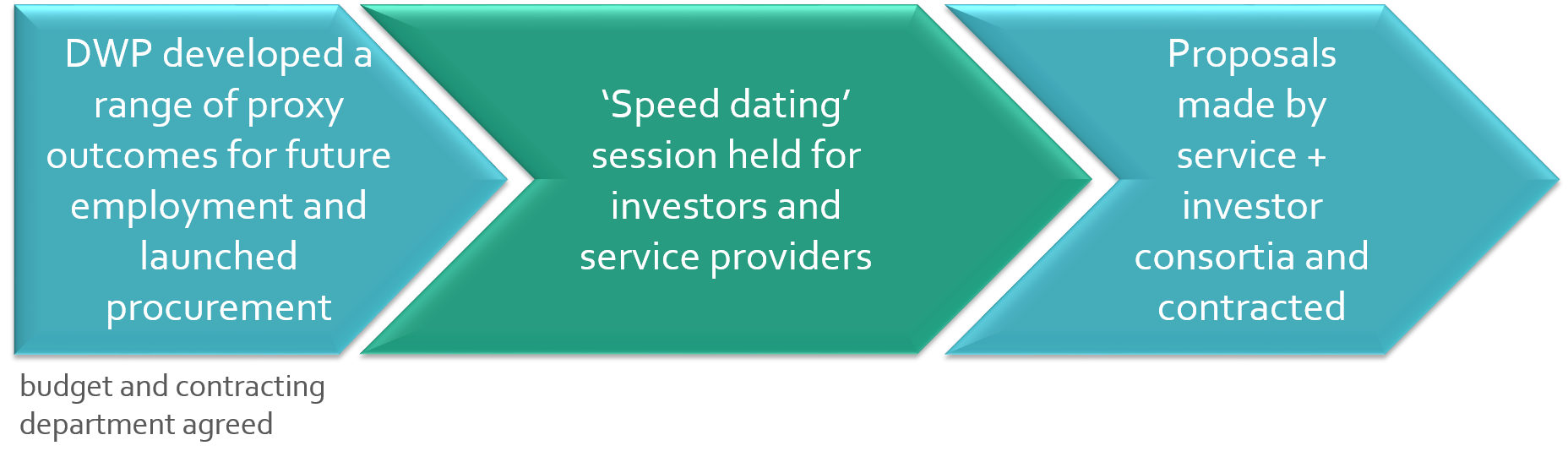
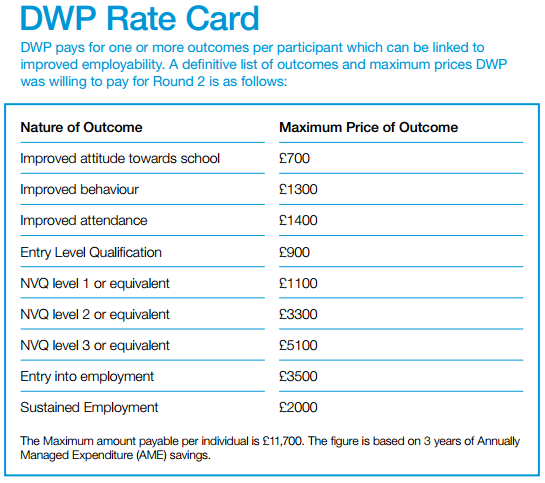
The Department of Work and Pensions developed a ‘rate card’ for payment per individual outcome for their procurement. They asked organisations to choose a subset of outcomes to deliver, nominate a price per outcome and the intervention that would achieve them. A social impact bond structure was not mandated – seven out of the ten chosen programs involved external investors. The following process occurred twice in 2012:

procurement DWP

DWP Rate Card: DWP pays for one or more outcomes per participant which can be linked to improved employability. A definitive list of outcomes and maximum prices DWP was willing to pay for Round 2 is:

DWP rate card

Saskatchewan, Canada

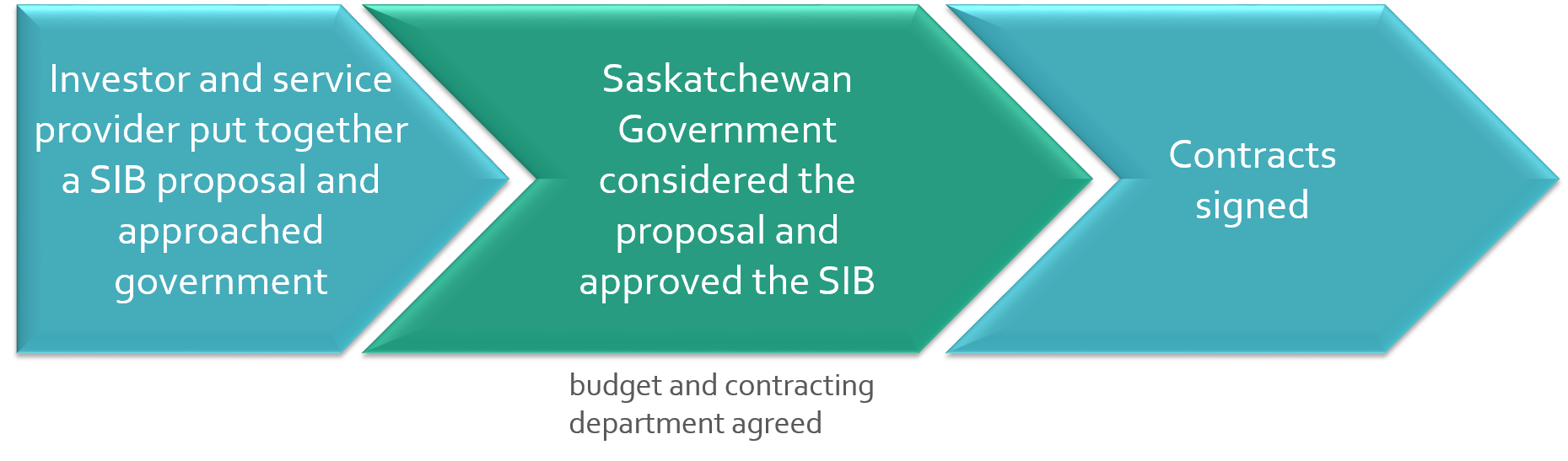
This process may be followed if an unsolicited proposal is received. An interesting feature of the Saskatchewan SIB is that the investor has also signed the contract with government.

procurement Saskatoon

Essex, UK

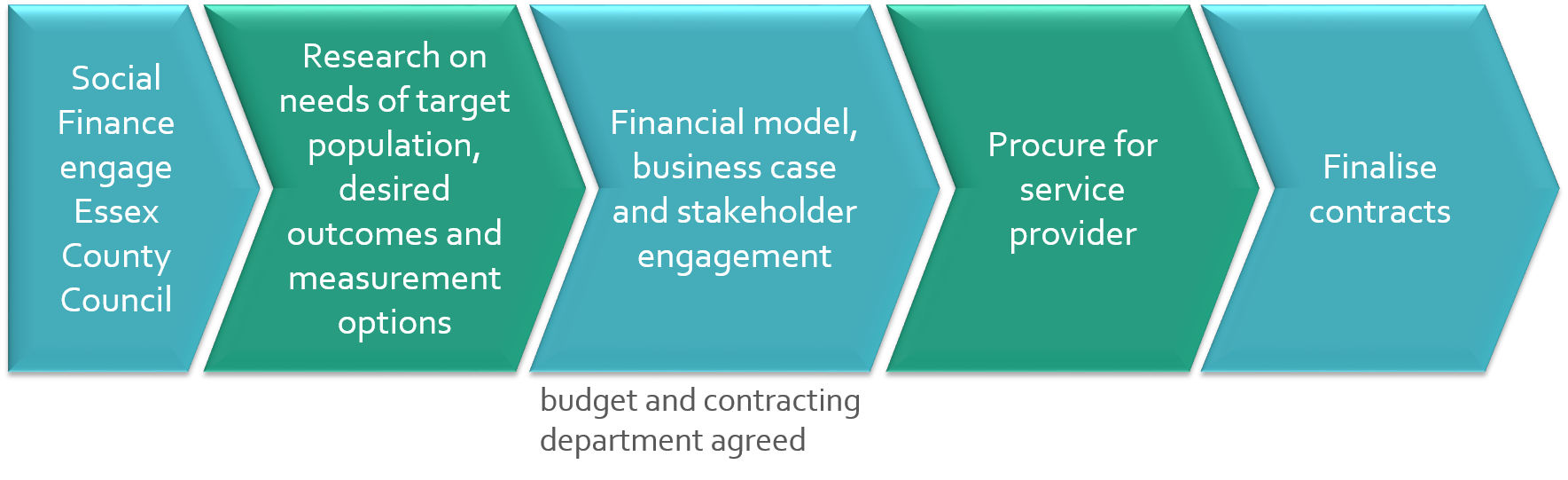
The process of developing the Essex social impact bond is described in Social Finance’s Technical Guide to Developing Social Impact Bonds. Social Finance worked closely with Essex County Council to research and develop a SIB, with the final step being procuring for a service provider.

procurement Essex

Conclusion

Governments need to think about which information need to be included in a procurement document. For example, if it is desired that organisations external to government come up with completely new service areas, then a procurement process that does not state the social issue to be addressed or contracting department might be suitable. But information and constraints that are known should be included in a tender document. It’s simply irresponsible to have a criminal justice organisation spend time working on a response offering intensive services for 30 female offenders if there was never any possibility the SIB was going to be in justice, or with female offenders, or with a small group of people.

Key questions when procuring for a social impact bond (SIB)

While SIBs can be brought to government through unsolicited proposals (in jurisdictions that allow this), most governments will procure for a SIB by going to market and asking for organisations to respond. (This approach to market is usually called a tender or Expression of Interest or Request for Proposals or something else with a different name but similar meaning.)

The question is, what to procure for?

  • an outcome?
  • an intermediary?
  • a service provider?
  • ideas for procurement?
  • ideas for SIBs that could be constructed in the future, should procurement proceed?
  • an organisation to tell government what to procure for?

The first step for government is clarifying its objectives in pursuing a SIB. SIBs are a catalyst for change, but different governments use them to change different things. (See analysis of stated objectives for the first few SIBs.) The objectives of government will make a big difference to how procurement is approached. For example, if a key objective is rigorous measurement of attribution, then a large population and randomised control trial might be required. If a key objective is to adequately fund small providers in remote locations to work together to help their communities, then ‘roadshows’ for awareness, accessible information and additional resources for capacity building might be part of the procurement process. If long-term funding for outsourced social programs is a big change for government, then it may require legislative change or significant work with internal government stakeholders to understand and manage perceived risks.

The main decisions government will need to make in deciding a SIB are:

  • Social issue area / Contracting department
  • Payment metric e.g. number of reconviction events or number of days happily employed
  • Maximum budget OR value per payment metric
  • Period of time over which budget will be deployed
  • Cohort / Referral mechanism

These decisions can be made before an approach to market, or after responses have been received. Some jurisdictions have asked their markets to suggest responses to almost all the above decisions, and some have made almost all of them internally before approaching the market.

The final decision is which organisation to contract with, which is usually (but not always e.g. Peterborough, Saskatoon) the result of a procurement process.

I haven’t spoken to anyone so far who thinks their procurement process was perfect, so let me know if you find one where all stakeholders agree it’s good!

Governments going to market with as much of the draft contract as possible may help speed and clarify the process. A lot of the contract will be relevant to most situations, so provision of basic clauses provides clarity and allows negotiation time to be focused on the issues that are new.

The following questions might be useful for governments to ask themselves when approaching procurement:

  • What are we trying to achieve or test?
  • Does it matter how much investors stand to return?
  • Does it matter how many organisations are involved in delivering the SIB and what their relationship is?
  • Does it matter how money flows?
  • What really matters to us?
    • service improvements in difficult areas?
    • innovation in services for populations of service failure?
    • a service model that can be used in other locations or service areas?
    • savings?
    • a shift of focus into preventative services?

Evidence-based justice – or NOT!

It’s hard to generate good evidence on which to base policy and programs. It’s even harder when that evidence exists, is publicly available and blatantly ignored.

Let’s talk about generating evidence first…

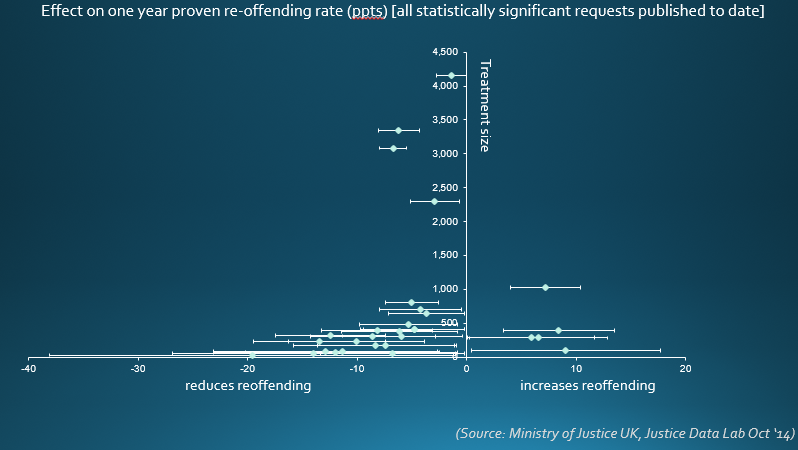
Sometimes when we talk about comparing a group receiving services to a group not receiving services, it is argued that it is unethical to deny anyone a service (this always comes up when planning social impact bonds and other pay for success programs). There is an underlying assumption in this argument that all services are beneficial to their recipients. Results from the Justice Data Lab in the UK show that services are not always beneficial, as some programs that intended to reduce reoffending actually increased reoffending.

Justice Data Lab Oct results

The Justice Data Lab was launched on a trial basis in April 2013. For organisations delivering services to reduce reoffending, it provided the first opportunity to have an effect size calculated against a matched national comparison group, for no financial cost. A key condition of the Justice Data Lab was that the Ministry of Justice would publish all results.

For more information on how the Lab works, see the brief summary I wrote last year.

Critics of the Justice Data Lab point out that organisations are able to choose which names they submit, so are able to bias the results. Despite this, not all results have been positive.

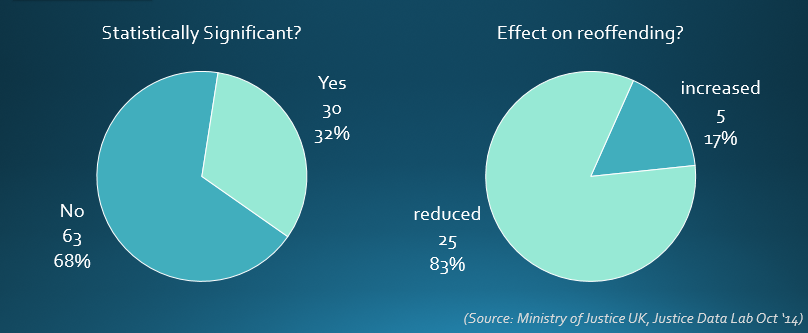
Up to October 2014, 93 programs have applied. Only 30 of these had statistically significant results. Of these, 25 were shown to reduce reoffending and five increased reoffending.

Justice Data Lab Oct results 2

[Technical note: Non-statistically significant results could be due to a number of features in combination, including small effect size (difference between those receiving the service and similar ex-offenders not receiving the service), small sample size (how many people were in the program) and low matching rate. The Justice Data Lab requires that at least 60 people’s names be submitted for matching with similar ex-offenders, but is not always able to match them all. If only 30 offenders were able to be matched, the program would have to have an effect size of at least 15 percentage points in order for the result to be statistically significant with 95% confidence. That is very high – only one of the programs so far has produced a difference of greater than 15 percentage points. (A confidence level of 95% means that if the program were repeated 100 times, at least 95 times the observed effect would be due to the program and the remaining times the observed effect would occur by chance.)]

The UK is currently undergoing a huge policy reform, Transforming Rehabilitation. What role the Justice Data Lab and its results will play in this process is unknown. Sometimes the hardest part of the evidence cycle is making decisions that reflect the evidence.

Disney’s anti-evidence programmingBeyond Scared Straight

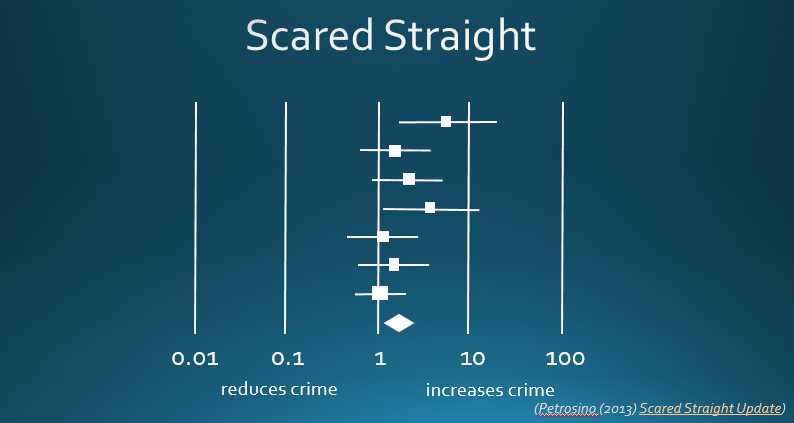
Perhaps the most notorious of programs that consistently increases reoffending is Scared Straight. Scared Straight involves taking young people into prisons, where they speak to incarcerated offenders and ‘experience’ being locked up. The idea is that they’re so shocked by what they see they will never offend themselves and risk a life behind bars. Unfortunately, for the young people participating in these programs, the incidence of prison increases.

Scared Straight programs spread across the US after a documentary of the same name won an Academy Award in 1979. The effect of many of these programs was not evaluated, but there were two studies published only a few years later, in 1982 and 1983, showing that out of seven evaluations, not once did the program reduce reoffending, and that overall the program increased reoffending. These analyses have been repeated several times, but the results remain the same (Petrosino (2013) Scared Straight Update).

Scared Straight

Despite this evidence being publicly available and fairly well known, in January 2011, the Disney-owned TV channel A&E began to broadcast their new series Beyond Scared Straight. The program follows “at-risk teens” and is “aimed at deterring them from a life of crime”. Despite outcry, public condemnation and petitions, the channel refuses to cancel the series, which is about to enter its eighth season.

The Washington State Institute for Public Policy estimates that each dollar spent on Scared Straight programs incurs costs of $166.88, making it the only juvenile justice program in their list with a negative cost:benefit ratio (see their summary below).

WSIPP Scared Straight

For the young people enticed into the program, their prize is not only a terrifying experience, but a greater likelihood of a stint in one of the unhappiest places on Earth.

Useful references

The Cochrane Collaboration – systematic reviews of evaluations in health.

The Campbell Collaboration – sister of Cochrane for other policy areas e.g. where the Scared Straight update is published.

Test, Learn, Adapt: Developing Public Policy with Randomised Controlled Trials – from the UK Cabinet Office clearly sets out how public programs can use randomised controlled trials to develop evidence-based programs. Rather than ‘denying’ service, the authors encourage randomisation of rollout of a new program, for example, as a cost-neutral way of enabling better data collection and learning.

Creating a ‘Data Lab’ – from NPC, about submitting the proposal that initiated the Justice Data Lab and continuing work to seed similar programs in other service areas.

Transforming Rehabilitation: a summary of evidence on reducing reoffending (second edition) – 2014 – published by the Ministry of Justice

What Works to Reduce Reoffending: A Summary of the Evidence – 2011 – published by the Scottish Government

The Peterborough Social Impact Bond (SIB) conspiracy

If you think Social Impact Bonds are the biggest thing to hit public policy EVER, then you were probably horrified at the cancellation of the final cohort of the flagship Peterborough SIB. How is it possible? What does it mean?

Since the news was broken in April this year (2014), I’ve had questions from as far afield as Japan and Israel trying to discover the UK Government’s TRUE agenda. More recently, at the SOCAP Conference in San Francisco in August, it was raised again. Eileen Neely from Living Cities, which has provided $1.5 million in loan financing for the Massachusetts Social Impact Bond was discussing “shut down risk: what happens if one of the parties decide they don’t want to play.”

She said, “In the Peterborough deal in the UK, the government decided that they weren’t going to play any more… so there’s some who say ‘Oh it’s because it wasn’t going well’ and others are saying ‘It was cos it was going too well’ so whichever it is, they decided that they weren’t going to do it, that they weren’t going to go into the next cohort, so what does that mean to the investors?” Eileen made it quite clear “I haven’t talked to any of the participants there, I’m just outside, reading the articles and the blogs …”

I thought it was about time we summarised the evidence for those who continue to ask these questions. Continue reading →

Rotterdam experiments with social impact bond

The first social impact bond (SIB) in the Netherlands got off the ground recently in Rotterdam. It takes the shape of a new financing instrument, with private investors providing municipal capital to help vulnerable groups in the labour market find employment. The greater the rate of success, the higher the yield. Els Sol gives us a local perspective on this development and warns against investors looking for quick returns.


els sol 035Els Sol works at the Amsterdam Institute for Advanced Labour Studies (AIAS), an institute for multidisciplinary research and teaching at the University of Amsterdam, The Netherlands and as scientific member of the investment committee of Start Foundation (www.startfoundation.nl). This article is a translation of a publication in Dutch in the 2014 September Issue of the Journal Zeggenschap, 2014, 32-34.


Dutch municipalities have been assigned responsibility for resolving a multitude of social problems including those related to healthcare and benefits. In many cases, the people concerned face multiple problems. The solution requires money and knowledge, neither of which are sufficiently available to the municipality. Take work reintegration for example. Municipalities find themselves facing harsh budget cutbacks in this field. Re-employment programmes, especially those for the unemployed facing multiple problems, are expensive and often require an approach that spans clearly defined municipal budget years. Not surprisingly, driven by budgetary discipline and deep cutbacks, municipalities have shifted their focus to reintegrating unemployed people who can find jobs relatively cheaply and easily. Consequently, more people at a greater distance from the labour market are being left out in the cold. Additionally, municipalities – especially the smaller ones – suffer from a lack of knowledge as to which labour market interventions actually succeed best in guiding their citizens into paid employment. This also ties in with budgetary disciplines that hamstring programmes spanning several years or requiring scaling-up, therefore generating insufficient information to adequately test whether the interventions are successful. Continue reading →

Social impact investment: Why are we here?

In the last two weeks I’ve been at two major social impact investing events, both of which were conducted in the language of investors, and both of which left me actively searching for the perspective of social purpose organisations. There’s a lot of discussion about what social purpose organisations need to do to get investment ready, but where’s the conversation about what investors need to do to get impact ready? SOCAP14 On September 3rd, the second night of the SOCAP conference, I attended an event held by Echoing Green, who support young social entrepreneurs. One of the young entrepreneurs was attending SOCAP.  Four of her friends excitedly asked her what it was like. She said “I don’t know. I’m still trying to figure out if it’s for me. I go to these sessions, but I don’t understand what they’re talking about.” I asked her what the issue was. She said the language and the concepts were so foreign to her that she struggled to find meaning in the proceedings. Only that morning, Sir Ronald Cohen had said, “that’s what impact investment is about: enabling social entrepreneurs whether they’re working through not-for-profits or for-profits, to raise the capital they need in order to improve the lives of others, or the environment”. How did we fail to communicate this to our target market? Continue reading →